
HANGZHOU, CHINA / ACCESS Newswire / November 8, 2026 / DEEP Robotics deployed humanoid robots at four key locations around Huanglong Sports Center for the 2026 Hangzhou Marathon on November 1, supporting traffic management and public assistance at an event with 36,000 runners. Jointly developed with local traffic police authorities, the bipedal robot “Hangxing No. 2” made its marathon debut, performing intersection monitoring, autonomous patrols, warnings against traffic violations, public information services, and interactive technology demonstrations. The deployment explored how embodied AI could support routine event operations and help establish a standardized approach to humanoid robot deployment at major sporting events.
The Hangzhou Marathon, a World Athletics Gold Label event, attracted more than 300,000 applicants for its 2026 edition. With the race starting at Huanglong Sports Center, large numbers of runners and spectators gathered in the surrounding area within a short period. Pre-race assembly, crowd movements during the race, and post-race dispersal brought overlapping pedestrian and vehicle flows, increasing the risk of unsafe road crossings and vehicles forcing their way through intersections. Repeated verbal instructions and hand signals place considerable demands on frontline officers, leaving fewer personnel available for emergencies and critical traffic management duties.
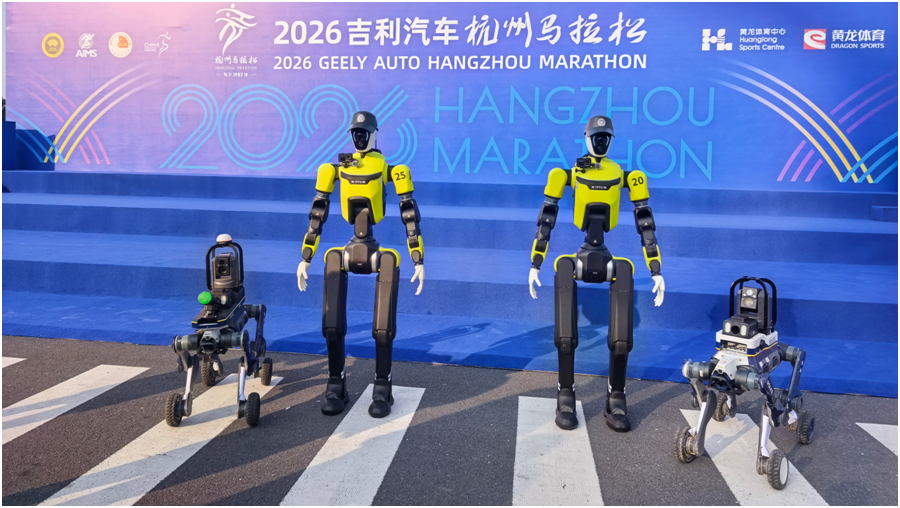
DEEP Robotics introduced its humanoid robots to take on repetitive monitoring and guidance tasks, allowing frontline officers to focus on emergencies and key traffic control points. By combining on-site monitoring, autonomous patrols, and public assistance, the deployment explored a practical model of human-robot collaboration for managing large crowds.
Supporting traffic management at key intersections
Major marathons place considerable pressure on traffic management and public safety operations. Runners and spectators arrive within the same time window, while temporary traffic arrangements introduce additional demands at intersections surrounding Huanglong Sports Center. From pre-race assembly and crowd dispersal after the starting gun to the movement of participants and spectators following the finish, traffic conditions change continuously throughout the event. Officers stationed at individual intersections often need to monitor several directions simultaneously.
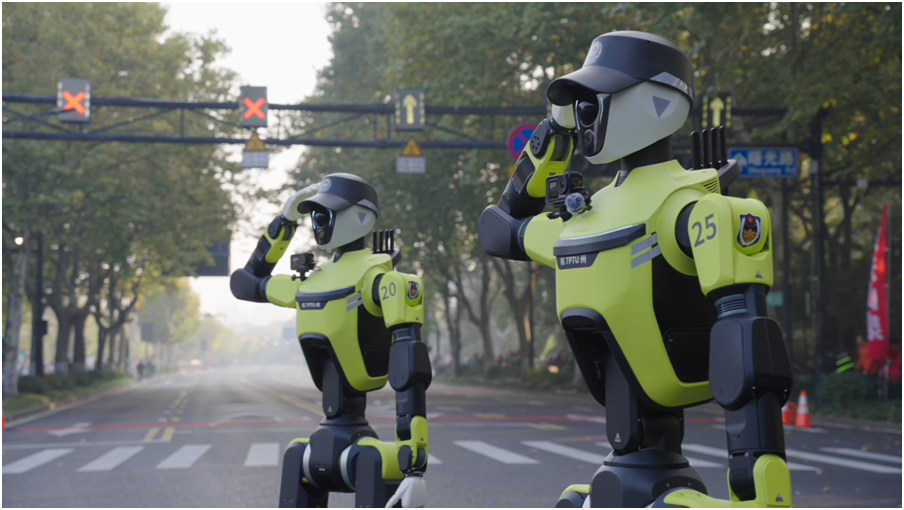
At the starting area and nearby major intersections, the “Hangxing No. 2” humanoid robot provided continuous on-site support in areas with heavy pedestrian traffic. Equipped with a multi-sensor environmental perception system and a high-precision motion control system, the robot can identify traffic violations in real time, such as unsafe pedestrian crossings and vehicles attempting to force their way through intersections. It automatically broadcasts traffic safety reminders and performs standardized traffic control gestures, assisting police officers in guiding pedestrian movements and maintaining order at key access points around the race’s starting area.
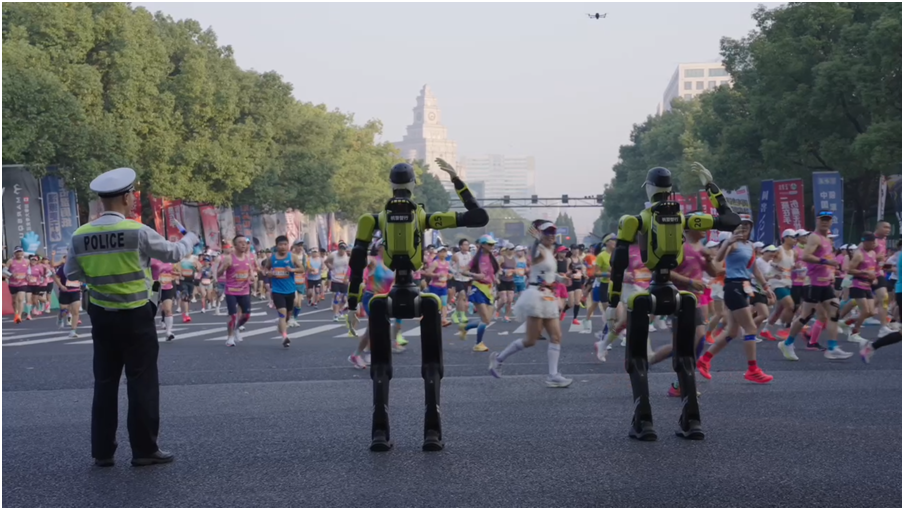
DEEP Robotics’ DR02 humanoid robot stands 178 cm tall, with a human-like design that allows it to operate in existing urban environments without requiring modifications to road infrastructure. The robot features an IP66 dustproof and water-resistant rating and is designed to operate reliably in temperatures ranging from −20°C to 55°C, enabling it to withstand rain, strong winds, and other challenging weather conditions and support uninterrupted duty throughout the event. Unlike human officers, who may experience fatigue during extended shifts, the robot can deliver consistent safety messages and perform standardized traffic guidance gestures without the same fatigue-related decline in performance. By taking on repetitive, labor-intensive roadside guidance tasks, it helps significantly reduce the operational burden on frontline traffic police.
Extending monitoring coverage through autonomous patrols
Crowd movements change throughout a marathon, while fixed surveillance systems may leave certain areas outside their coverage. To address these challenges, DEEP Robotics deployed its humanoid robots as mobile intelligent sentries, extending security monitoring beyond fixed observation points. Equipped with a computing unit delivering 275 TOPS of AI computing performance and a multi-sensor fusion system incorporating LiDAR, depth cameras, and wide-angle cameras, the robots conduct autonomous patrols along predefined routes around the venue. They can move between designated monitoring locations as needed, supplementing fixed surveillance systems and helping reduce coverage gaps.
The robots also feature intelligent obstacle avoidance capabilities. When encountering pedestrians crossing their paths or obstacles blocking a route, they can automatically stop and wait or navigate around the obstruction. If a passage becomes impassable, the robot automatically ends its patrol and switches to a safe standby mode. Through coordinated deployment, multiple robots form a mobile sensing network across several locations, enabling continuous monitoring of changing conditions around the venue. This approach improves security coverage and the continuity of risk monitoring and early warnings, contributing to a mobile, all-weather security system capable of adapting to dynamic event conditions.
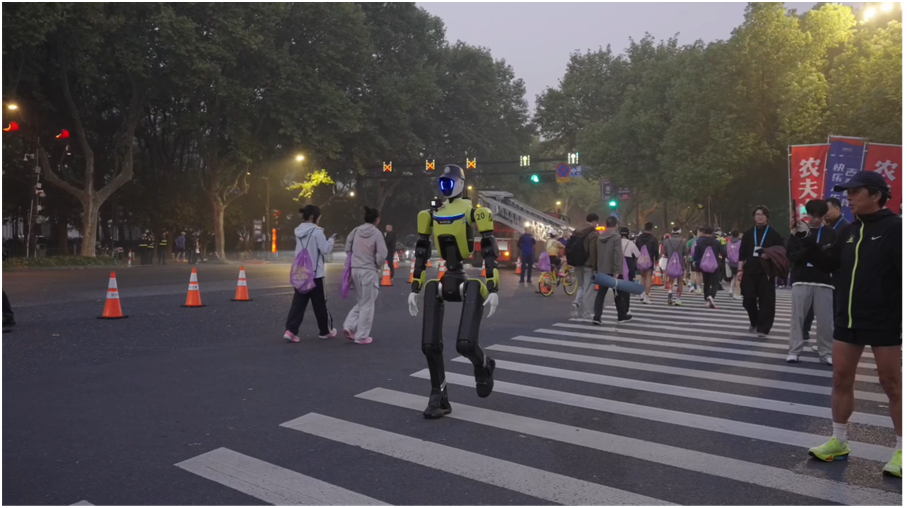
Handling routine inquiries to support frontline officers
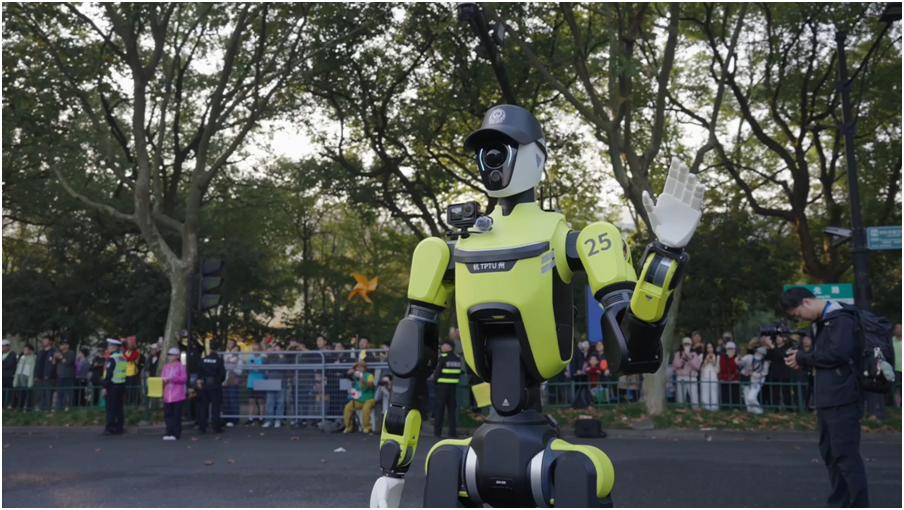
During peak arrival and departure periods, the number of public inquiries around the venue rises sharply. Repeated requests for directions and basic event information can consume considerable time and attention from officers responsible for maintaining order. To help address this challenge, DEEP Robotics stationed its humanoid robots in areas with high concentrations of visitors. The robots provided voice announcements, automated responses to public inquiries, and interactive demonstrations covering event-related traffic information, nearby public facilities and services, and traffic safety guidance.
By handling frequently asked questions and other routine inquiries, the robots allowed police officers to devote more attention to situations requiring human judgment, including individual requests for assistance, unexpected disputes, and on-site emergencies. This arrangement expanded the availability of public information services while supporting more efficient deployment of police resources. As one officer on duty explained: “The robots have taken over much of the repetitive announcement and inquiry work, allowing us to devote more attention to responding to emergencies.”
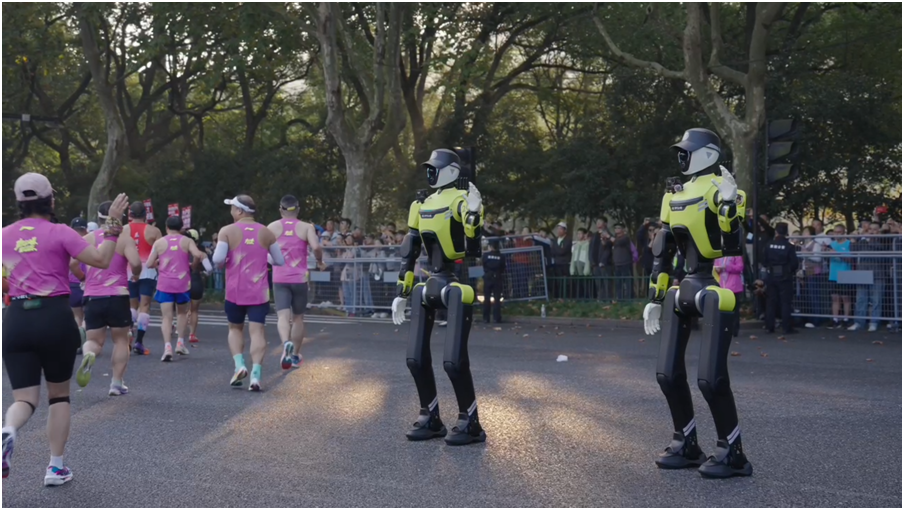
Preparing for deployment through real-world testing
Security operations at major events leave little room for trial and error. To ensure that its robots could operate safely and reliably in environments involving tens of thousands of people, DEEP Robotics conducted several rounds of real-world stress testing before the marathon, placing the equipment under realistic operating conditions to identify potential risks and optimize performance.
During a holiday period in early October, DEEP Robotics’ humanoid robots were deployed at busy local intersections. They were also tested at Xixi National Wetland Park, where heavy visitor traffic and sustained rainfall provided an opportunity to assess their ability to operate continuously under challenging conditions. On October 25, a large music festival at Huanglong Sports Center attracted approximately 37,000 spectators. Concentrated flows of tens of thousands of people entering and leaving the venue, combined with high crowd density, ambient noise, and heavy communication demands, created a demanding environment for evaluating equipment reliability. During the festival, the humanoid robots underwent systematic testing across four key scenarios: intersection management, autonomous patrols along perimeter roads, high-volume human-robot interaction, and communication and remote takeover capabilities. Further testing took place from October 29 to 31 during the Hangzhou Marathon Expo, when two robots were deployed inside the venue to refine their human-robot interaction, autonomous navigation, and direction-giving and guidance capabilities. Strict safety boundaries were maintained throughout all testing activities. Extreme obstacle avoidance tests were not conducted in densely crowded areas, and spectators were not used as test subjects, ensuring that testing proceeded safely and in an orderly manner. Following three rounds of real-world testing and refinement, the robots met the required operational performance criteria and were formally deployed to support the Hangzhou Marathon, demonstrating their readiness for practical event operations.
The deployment brought DEEP Robotics’ humanoid robots beyond exhibition demonstrations and into operational roles at a major public event. It offered a practical setting for assessing how embodied AI can respond to the everyday needs of urban traffic management.
The role of the robots was to support frontline officers by handling repetitive, labor-intensive duties. Officers remained responsible for complex incidents requiring human judgment and immediate intervention, while robots assisted with traffic guidance, patrols, and routine public inquiries.
Following the marathon, DEEP Robotics will work with the relevant authorities and partners to review the deployment and refine procedures for on-site monitoring, autonomous patrols, traffic guidance, and public information services. The aim is to develop a replicable, scalable approach to traffic management at major sporting events and provide practical experience for the wider use of embodied AI in public services.
Media Contact
Company: DEEP Robotics
Contact: Vivian Chen
Email: chenlingjia@deeprobotics.cn
Website: https://www.deeprobotics.cn/en
SOURCE: DEEP Robotics
View the original press release on ACCESS Newswire


