Diesel engines are projected to grow at a CAGR of 3.8% through 2035, sustained by heavy-duty trucking, marine propulsion, and off-highway equipment demand.
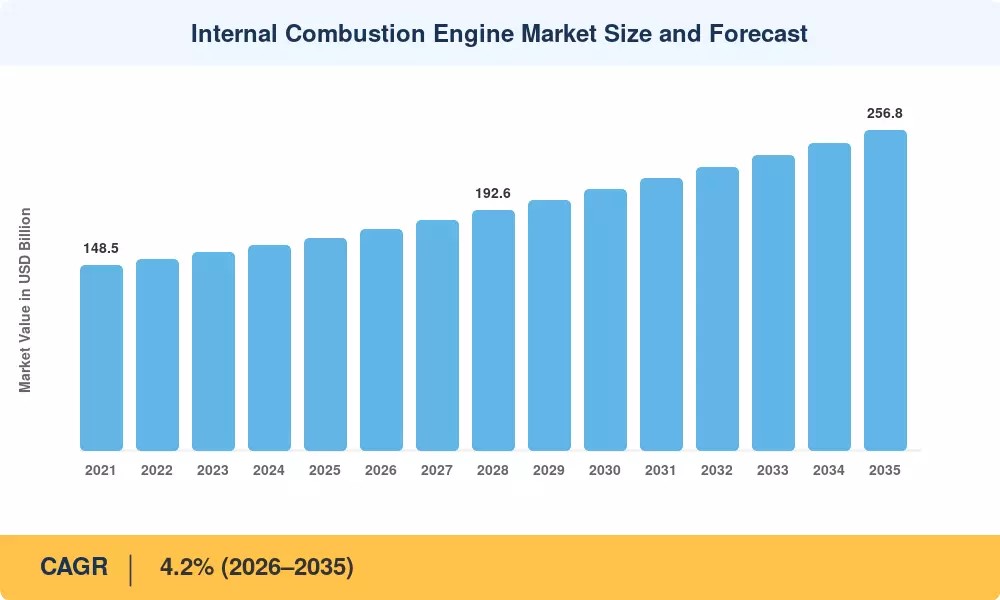
NEW YORK, NY, UNITED STATES, July 29, 2026 /EINPresswire.com/ — The Internal Combustion Engine Market was valued at USD 170.2 billion in 2025 and is projected to reach USD 177.3 billion in 2026 before climbing to USD 256.8 billion by 2035, expanding at a compound annual growth rate of 4.2% during the 2026–2035 forecast period.
Market Overview
Internal combustion engines market remain the dominant powertrain technology across global transportation, industrial, and power generation sectors, converting the chemical energy of fuels such as gasoline, diesel, and natural gas into mechanical power through controlled combustion within a confined chamber. Despite the accelerating transition toward electric mobility, the internal combustion engine market retains its scale and relevance due to the enormous installed base, mature fuel infrastructure, and cost dynamics that remain difficult to displace in the near to medium term. The technology continues to power passenger vehicles, commercial trucks, marine vessels, aircraft, agricultural machinery, and backup power systems across developed and emerging economies .
Two primary catalysts underpin the market’s growth trajectory: the accelerating global demand for commercial freight transport, which the International Energy Agency estimates will grow cumulative diesel fuel demand by 18% through 2035, and rising industrial backup power requirements across data-center-heavy economies. The global data center sector consumed roughly 460 TWh of electricity in 2024, with regulations in markets such as the United States mandating on-site backup generation capacity, predominantly served by diesel generator sets rated above 1 MW. This represents a USD 4–6 billion annual addressable market for industrial-grade combustion engines .
A significant technology transformation is reshaping how combustion engines are designed, manufactured, and deployed. Legacy naturally aspirated configurations are giving way to advanced turbocharged, downsized architectures that extract more power per liter while cutting CO₂ output by 15–20%. Hybrid integration is bridging the gap between pure combustion and full electrification across passenger and commercial segments. The market is evolving into a more segmented landscape, with future growth increasingly concentrated in applications where electrification faces greater hurdles, such as heavy-duty transport, maritime, and off-road equipment, while its share in passenger cars gradually declines .
Asia-Pacific dominates the internal combustion engine market with approximately 42% of global revenue, driven by manufacturing scale in China, India, and Japan, while also registering the fastest CAGR at 5.1% through 2035. North America holds roughly 24% share, anchored by heavy-duty trucking and oil-and-gas sector demand, while Europe contributes around 22%, where stringent emissions rules paradoxically stimulate premium engine innovation. The decade ahead will hinge on how effectively OEMs balance regulatory compliance with profitability across these three regions.
📍 Get Free Sample Report for Detailed Market Insights:
https://www.marketresearchfuture.com/sample_request/28193
Market Segmentation
The internal combustion engine market is comprehensively segmented across fuel type, application, and engine configuration to capture diverse industry dynamics and regional variations.
By fuel type, gasoline engines command the largest share at approximately 48% of 2025 revenue, supported by passenger vehicle volume across Asia-Pacific and North America. Turbocharged three- and four-cylinder architectures have become the standard configuration, delivering power densities that match or exceed legacy six-cylinder designs while meeting tightening fuel economy standards. Diesel engines are projected to grow at a CAGR of 3.8% through 2035, sustained by heavy-duty trucking, marine propulsion, and off-highway equipment demand, where torque density and fuel efficiency remain non-negotiable. Natural gas engines represent a USD 12.4 billion segment in 2025, benefiting from LNG-fueled power generation in the Middle East and Southeast Asia, while alternative fuel options including LPG, dual-fuel, and hydrogen are experiencing the fastest growth at a 6.7% CAGR, driven by pilot hydrogen programs and alternative fuel mandates .
By application, automotive accounts for approximately 58% of the market, with light commercial vehicles driving incremental growth in emerging economies. Industrial and power generation applications are expanding at the fastest CAGR of 5.3%, propelled by the global data center construction boom, mining operations, and distributed generation. The marine segment represents a USD 14.7 billion market, sustained by IMO compliance and fleet expansion in LNG carriers, while off-highway and agriculture applications account for 12% of revenue, driven by mechanization in emerging markets. By engine type, four-stroke engines dominate with 88% revenue share, while two-stroke architecture survives in ultra-large marine applications.
🛒 You can buy this market report at:
https://www.marketresearchfuture.com/checkout?currency=one_user-USD&report_id=28193
Regional Analysis
The internal combustion engine market exhibits distinct regional dynamics shaped by industrial structure, regulatory regimes, and infrastructure maturity. Asia-Pacific holds the largest share at 42% of global revenue, led by China which accounts for 46% of regional revenue as the world’s largest vehicle producer and industrial genset base. India is registering the fastest growth at 5.8% CAGR, driven by rising vehicle ownership, BS-VII compliance investments, and the country’s production-linked incentive scheme allocating INR 259 billion to domestic powertrain manufacturing. Japan, valued at USD 9.2 billion in 2025, remains the global benchmark for thermal efficiency, with Toyota and Honda pushing brake thermal efficiency above 50% in production-intent gasoline engines .
North America contributes approximately USD 40.8 billion in 2025, with the United States accounting for 78% of regional revenue driven by Class 8 trucking, data center backup, and oil-and-gas applications. The US Department of Energy allocated USD 1.5 billion through the SuperTruck III program to develop next-generation heavy-duty powertrain technology targeting 55% brake thermal efficiency. Europe holds 22% share, where Germany accounts for 28% of regional revenue through premium OEM engine platforms and industrial CHP systems, while France, the UK, and Nordic countries contribute through marine diesel, agricultural equipment, and shipping applications. Europe’s regulatory environment, while the most restrictive globally, paradoxically strengthens the market by forcing continuous technology advancement through the Clean Industrial Deal and Euro 7 standards .
South America and the Middle East & Africa represent dynamic growth markets. Brazil leads South America with 62% of regional revenue through its unique ethanol flex-fuel engine market, where over 80% of new passenger cars operate on E85 or E100. The Middle East & Africa region posts the second-fastest regional CAGR at 4.8%, fueled by oil-and-gas infrastructure and distributed power generation, with Saudi Arabia accounting for 32% of regional revenue through industrial gensets and petrochemical facility power. Grid reliability challenges across Sub-Saharan Africa, where Nigeria alone operates an estimated 60 million small diesel and gasoline generators, make combustion-engine-based generation indispensable.
Competitive Landscape
The internal combustion engine market is moderately fragmented, with an estimated top five players holding a combined revenue share of approximately 28–33%. Competition varies sharply by application: automotive engines are consolidated among a handful of global OEMs, while industrial and marine segments feature specialized manufacturers with deep domain expertise. Strategic positioning increasingly centers on fuel-agnostic platform architectures and digital service revenue.
Cummins Inc. leads with approximately 6–8% market share, offering the broadest power range across diesel and natural gas engines for heavy-duty and power generation applications, while positioning as a hydrogen combustion R&D leader. Caterpillar Inc. holds 5–7% share through industrial diesel engines, gensets, and marine propulsion, leveraging an integrated equipment and aftermarket service ecosystem. Toyota Motor Corporation commands 4–6% share with gasoline and hybrid passenger vehicle engines, setting thermal efficiency benchmarks through hybrid architecture innovation. Volkswagen Group holds 4–5% share through volume-scale automotive engines and modular platform strategy. INNIO and Wärtsilä Corporation each hold 3–4% share in gas engines for distributed power and medium-speed marine applications, with Wärtsilä advancing ammonia-ready platforms for multi-fuel flexibility. Other significant players include MAN Energy Solutions, Rolls-Royce Power Systems, Stellantis, and Weichai Power .
Latest Industry News & Developments
In September 2024, Caterpillar expanded its Cat Dynamic Gas Blending engine lineup for oil-and-gas well service applications, enabling up to 85% natural gas substitution in fracturing operations. In June 2024, the India Ministry of Heavy Industries extended the Production-Linked Incentive scheme for automotive components through 2028, allocating an additional INR 50 billion to domestic engine and powertrain manufacturing. The European Commission announced the Clean Industrial Deal in early 2025, earmarking EUR 8 billion for industrial decarbonization technologies, including advanced combustion systems paired with carbon capture.
Market Challenges & Opportunities
Battery electric vehicle adoption displacement represents the most significant challenge, with BloombergNEF estimating EVs will account for roughly 45% of new passenger car sales globally by 2035, directly reducing addressable unit volume for the internal combustion engine market in the passenger segment. Urban access restrictions in more than 320 European cities, including London’s Ultra Low Emission Zone expansion and Berlin’s diesel bans, shrink the addressable market for older combustion engines and accelerate scrappage cycles. Decarbonization policy pressure from California’s Advanced Clean Fleets rule, mandating zero-emission medium- and heavy-duty vehicles by 2036, influences fleet procurement planning and dampens long-range market forecasts .
However, significant opportunities are emerging across multiple dimensions. Hydrogen-blended and dual-fuel combustion engines are seeing heavy investment, with 20–40% hydrogen substitution lowering well-to-wheel CO2 by up to 35% without requiring a full powertrain overhaul, extending the commercial life of the market past 2040. Distributed power generation in off-grid markets represents a substantial opportunity, with the World Bank’s Scaling Mini-Grids program pledging USD 2.1 billion to decentralized generating projects serving the 600 million people lacking reliable grid access. Aftermarket digital services and predictive maintenance solutions, such as Caterpillar’s Cat Connect and Wärtsilä’s Expert Insight, offer recurring software revenue by improving engine availability by 12–18%. Marine propulsion retrofit and compliance, driven by IMO 2030 interim targets, represents an USD 8–10 billion opportunity through 2035 for retrofitting existing vessels with emission control systems .
To explore more market insights, visit us at:
https://www.marketresearchfuture.com/reports/internal-combustion-engine-market-28193
Final Market Summary
The internal combustion engine market is positioned for steady growth, with projections indicating an increase from USD 170.2 billion in 2025 to USD 256.8 billion by 2035, at a CAGR of 4.2%. This growth is underpinned by sustained commercial freight transport demand, rising industrial backup power requirements, and the entrenched position of combustion technology across heavy-duty, marine, and off-highway applications where electrification faces economic and infrastructure constraints. While challenges including EV adoption displacement, urban access restrictions, and decarbonization policy pressure persist, emerging opportunities in hydrogen-blended engines, distributed power generation, aftermarket digital services, and marine retrofit compliance offer significant potential for industry participants. The future market landscape will be defined by companies that successfully navigate regulatory fragmentation, invest in fuel-agnostic platform architectures, and leverage digital service revenue models while balancing compliance with profitability across diverse global markets.
More Related Reports from MRFR Library:
Submersible Pumps For Mining Sector Market: https://www.marketresearchfuture.com/reports/submersible-pumps-for-mining-sector-market-5050
Marine Fuel Optimization Market: https://www.marketresearchfuture.com/reports/marine-fuel-optimization-market-5052
Gas to Liquid Market: https://www.marketresearchfuture.com/reports/gas-to-liquid-market-5053
South America & Africa Diesel Generator Market: https://www.marketresearchfuture.com/reports/south-america-africa-diesel-generator-market-5205
Wind Tower Market: https://www.marketresearchfuture.com/reports/wind-tower-market-5265
Air Compressor Market: https://www.marketresearchfuture.com/reports/air-compressor-market-5272
Solar Street Lighting Market: https://www.marketresearchfuture.com/reports/solar-street-lighting-market-5350
Low Voltage Switchgear Market: https://www.marketresearchfuture.com/reports/low-voltage-switchgear-market-5365
Instrument Transformer Market: https://www.marketresearchfuture.com/reports/instrument-transformer-market-5403
Self Healing Grid Market: https://www.marketresearchfuture.com/reports/self-healing-grid-market-5442
Larry Wilson
WantStats Research And Media Pvt. Ltd.
+ +1 855-661-4441
email us here
Visit us on social media:
LinkedIn
Facebook
YouTube
X
Legal Disclaimer:
EIN Presswire provides this news content “as is” without warranty of any kind. We do not accept any responsibility or liability
for the accuracy, content, images, videos, licenses, completeness, legality, or reliability of the information contained in this
article. If you have any complaints or copyright issues related to this article, kindly contact the author above.

Media gallery