New research across 42 incidents, from MGM to the 2026 Canvas hack: 83% of first statements hide what was stolen, and 1 in 4 firms never name a victim count
NY, UNITED STATES, July 28, 2026 /EINPresswire.com/ — Companies that understate the scale of a data breach in their first statement draw hostile media coverage twice as often as companies whose first numbers hold up 65% versus 32% according to a new study by OTReniX Cybersecurity marketing and PR firm. The agency tracked 42 major incidents disclosed between January 2023 and July 2026: what each company said first, when, how the numbers changed, and what followed.
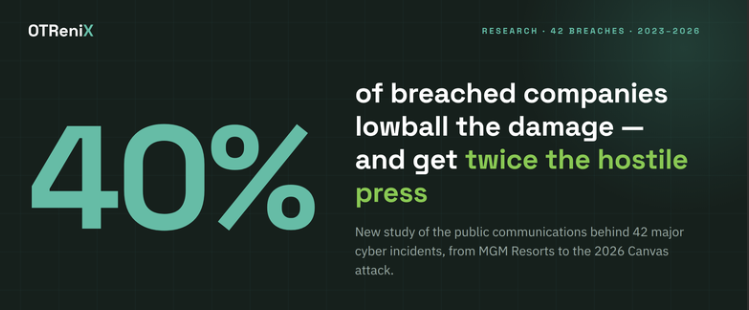
Forty percent of the companies opened with a reassuring figure or a denial that later collapsed. Okta’s “134 customers, about 1%” became every user of its support system. Change Healthcare went from no number to 190 million — the largest healthcare breach in US history. The UK’s Co-op said there was “no evidence of data compromise” two days before hackers showed the stolen data to the BBC.
Key findings:
– 40% understated the damage, then corrected upward and drew hostile coverage in 65% of cases.
– 1 in 4 never said how many people were hit; journalists and hackers supplied the numbers instead.
– 83% opened with a euphemism “security incident” instead of naming what was stolen.
– The median company took 4 days to speak; 37% stayed silent for more than a week.
– 26% lost control of the story: attackers, journalists, or researchers broke the news first.
– Only 40% put a named executive in front of the story. Regular updates cut hostile coverage from 57% to 38%.
The companies that kept their reputation – Bybit, Coinbase, Qantas – all did the same three things: spoke fast, showed a face, and never stated as fact what they merely hoped.
The study also documents the failures: 23andMe telling victims the breach was “their fault” before filing for Chapter 11; Workday hiding its disclosure page from search engines with a “noindex” tag; Instructure declaring the 2026 Canvas incident “resolved” one day before attackers defaced 330 school login pages.
The disclosure window is also closing legally, the study notes: the SEC requires a filing within four business days of a materiality determination, GDPR gives 72 hours to notify regulators, and US state attorneys general run their own notification clocks. The median company in the sample spoke after 4 days; the average, dragged up by a long tail of silence, was 10.7 days.
The full report: https://otrenix.com/cybersecurity-pr-agency/#research
About OTReniX
OTReniX is a cybersecurity marketing and PR agency. We help infosec vendors earn visibility and trust: media relations, crisis communications, analyst relations, thought leadership, and full-stack marketing — locally and globally. More at otrenix.com.
Leo Schwarzebart
OTReniX
+1 315-202-9281
email us here
Legal Disclaimer:
EIN Presswire provides this news content “as is” without warranty of any kind. We do not accept any responsibility or liability
for the accuracy, content, images, videos, licenses, completeness, legality, or reliability of the information contained in this
article. If you have any complaints or copyright issues related to this article, kindly contact the author above.

Media gallery