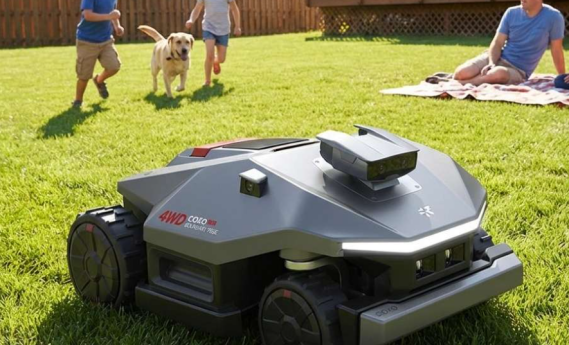
OR, UNITED STATES, July 3, 2026 /EINPresswire.com/ — Intelligent robotic lawn mowers have become a mainstream lawn care solution for North American households, effectively solving the hassle of manual mowing. As the industry’s core navigation technologies, standard GPS and high-precision RTK positioning directly determine a robot mower’s cutting accuracy, environmental adaptability and overall automation performance. For homeowners looking to upgrade their lawn maintenance equipment, distinguishing the differences between traditional GPS and RTK robot mower systems is the key to making a cost-effective purchase decision. This guide objectively analyzes the principles, pros and cons, and applicable scenarios of the two technologies, and takes the industry-typical multi-sensor fusion model — the GoKo M6 robot mower — as a core case to interpret the technical advantages of mainstream high-end wire-free mowers.
Understanding Satellite Navigation for Robot Mowers
Both GPS and RTK positioning rely on the Global Navigation Satellite System (GNSS), covering global satellite systems such as GPS, GLONASS, Galileo and BeiDou. The core working principle is for the device’s built-in receiver to capture satellite signals and calculate real-time geographic coordinates through signal transmission time differences. The biggest gap between the two lies in positioning accuracy and anti-interference capability, which leads to completely different lawn mowing performances in actual use.
Ordinary consumer-grade GPS features low cost and wide compatibility, with a positioning error of 2 to 10 meters. This accuracy is sufficient for daily vehicle navigation but far from meeting the fine trimming requirements of lawns. In contrast, RTK robot mower technology is optimized for high-precision scenarios, becoming the core configuration of current high-performance intelligent lawn mowers.
Working Principles and Limitations of GPS-Only Robot Mowers
Most entry-level robot mowers on the market adopt standalone GPS navigation, assisted by basic on-board sensors and obstacle detection modules. This solution can realize simple functions such as lawn zone identification, mowing track recording and equipment anti-theft positioning, meeting the most basic lawn maintenance needs of small, flat yards.
However, GPS signals are easily affected by atmospheric changes, building occlusion and dense tree canopies, resulting in inevitable signal drift and positioning deviation. Mowers relying solely on GPS often suffer from uneven cutting, missing edges and repeated overlapping mowing. Due to the lack of centimeter-level precise path planning capabilities, pure GPS models struggle to form neat, uniform lawn stripes, limiting their performance in complex and high-precision mowing scenarios.
How RTK Robot Mowers Achieve Centimeter-Level Precision Mowing
RTK (Real-Time Kinematic) real-time dynamic positioning is an upgraded satellite navigation technology tailored for high-precision intelligent equipment. Different from the single signal timing calculation of GPS, an RTK robot mower analyzes satellite signal carrier waves and corrects positioning errors in real time through fixed base stations or network RTK (NRTK) service systems.
The fixed reference base station has accurate fixed coordinates, which can monitor satellite signal errors in real time and transmit correction data to the mower. After calibration, the positioning accuracy can reach 1 to 3 centimeters, enabling the equipment to plan orderly, edge-to-edge and non-overlapping mowing paths. This stable high precision allows the mower to maintain consistent and fine trimming effects for a long time.
It is worth noting that pure RTK navigation also has environmental limitations. Dense shelters will weaken satellite signals. Therefore, excellent high-end mowers will adopt a multi-sensor fusion strategy to make up for the shortcomings of single satellite navigation. As a representative model of this technical solution, the GoKo M6 optimizes the traditional single RTK robot mower navigation mode, integrating RTK high-precision positioning with visual SLAM, inertial measurement units and wheel tracking systems. When satellite signals are temporarily blocked, the auxiliary sensing system can take over navigation in real time, ensuring uninterrupted and stable mowing operations.
Core Practical Differences Between GPS and RTK Robot Mowers
Combined with actual household lawn use scenarios, the core differences between the two navigation technologies are summarized below, serving as an important reference for user selection:
•Positioning Accuracy: Standalone GPS provides meter-level positioning with large error fluctuations; mature RTK robot mower equipment represented by GoKo M6 realizes stable centimeter-level precise positioning.
•Mowing Finish Quality: GPS-only mowing tracks are rough with obvious missing and overlapping areas; RTK precise positioning supports standardized striping, delivering a professional and neat lawn finish.
•Installation & Setup: Both support wire-free operation, but only RTK’s high precision can ensure the stability of virtual boundaries. GoKo M6 completely abandons traditional buried boundary wires, realizing one-click virtual zoning via APP with flexible and adjustable mowing ranges.
•Environmental Adaptability: Both technologies require basic open sky conditions. By virtue of multi-sensor fusion configuration, GoKo’s RTK system effectively improves the anti-interference ability in complex scenarios such as tree-shaded lawns and sloped yards.
•Cost & Value: RTK hardware and calibration services increase equipment costs, but they significantly reduce manual intervention and improve lawn maintenance quality, with higher long-term use value.
Wire-Free Technology: The Core Evolution of Modern Robot Mowers
Traditional robot mowers rely on buried boundary wires to define mowing areas, which are not only time-consuming and labor-intensive to install, but also prone to damage and difficult to adjust. The popularization of RTK high-precision positioning has completely promoted the iterative upgrade of wire-free mowing technology.
The core advantage of wire-free mowing lies in flexible and intelligent boundary management, and this function is completely dependent on high-precision positioning support. Taking the GoKo M6 wire-free RTK robot mower as an example, users can freely set no-go zones and mowing zones through the mobile APP, adjust the lawn coverage range at any time, and completely avoid the construction and maintenance troubles of traditional wired models.
Scenario-Based Selection Guide: GPS vs RTK Mowers
There is no absolute good or bad between GPS and RTK navigation technologies; the optimal choice depends on lawn size, terrain complexity and personal maintenance needs.
For small, flat and regular residential lawns with a limited budget, a high-quality GPS robot mower with complete auxiliary sensors can fully meet daily basic mowing needs, with high cost performance.
For large-area yards, sloped terrains, and irregular lawns that pursue fine trimming and low supervision, an RTK robot mower is the more professional choice. In particular, models with multi-sensor fusion configuration like the GoKo M6 can adapt to complex terrain and semi-shaded environments, solving the pain points of unstable operation of ordinary single RTK mowers.
Industry Trend: Dual-Technology Complementary Navigation
The current robot mower industry is gradually moving away from single-technology competition, forming a dual-navigation pattern of GPS and RTK complementary cooperation. High-end mainstream models no longer rely on RTK or GPS alone, but combine the advantages of both technologies.
The GoKo M6 fully embodies this industry trend in its technical configuration: it takes RTK multi-sensor fusion as the core to undertake high-precision mowing and path planning work, and uses traditional GPS positioning for auxiliary functions such as equipment real-time positioning and anti-theft tracking. This collocation perfectly avoids the low precision of pure GPS and the signal sensitivity of pure RTK, realizing all-scene stable intelligent mowing.
Final Takeaways
The essential difference between GPS and RTK robot mower systems is precision and scenario adaptability. Standalone GPS is suitable for basic and low-budget lawn maintenance scenarios, while RTK high-precision positioning is the core of high-efficiency, low-supervision and wire-free intelligent mowing.
For households with complex terrains, large lawn areas and high requirements for trimming effects, multi-sensor fused RTK mowers represented by GoKo M6 are more in line with the long-term intelligent lawn maintenance needs, and also represent the mainstream development direction of the robot lawn mower industry in 2026.
goko
goko
+1 866-796-8131
email us here
Legal Disclaimer:
EIN Presswire provides this news content “as is” without warranty of any kind. We do not accept any responsibility or liability
for the accuracy, content, images, videos, licenses, completeness, legality, or reliability of the information contained in this
article. If you have any complaints or copyright issues related to this article, kindly contact the author above.

Media gallery