REMAX APRIL 2026 NATIONAL HOUSING REPORT
PR Newswire
DENVER, May 19, 2026
New listings outpaced home sales in April as inventory increased
DENVER , May 19, 2026 /PRNewswire/ — Home sales increased in April, but the number of new listings outpaced demand, creating more available inventory and continuing a shift toward a more balanced housing market.
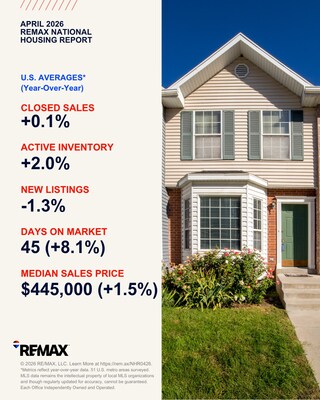
Typical for the spring selling season, April home sales grew 7.6% over March, while new listings increased 10.5% during the month. Across the 51 metro areas surveyed, year-over-year activity was largely unchanged, with sales up just 0.1% and new listings down 1.3%.
The number of homes for sale grew 4.5% over March 2026 and 2.0% year over year. The median sales price increased 1.5% to $445,000 – the 34th consecutive month of year-over-year price appreciation.
“April’s housing data shows a market that’s continuing to find its balance,” said REMAX® President and Chief Growth Officer Chris Lim. “More homes came onto the market faster than buyers were purchasing, which means buyers had more choices than they’ve had in a while. At the same time, prices were stable. Overall, it’s a steadier, less competitive environment than we’ve seen recently, and that’s giving both buyers and sellers a better chance to make confident decisions.”
Baltimore, Maryland, ranked among the top five metro areas for the largest year-over-year decline in new listings, down 23.4%. Month over month, however, the market landed closer to the national average, with listings rising 12.5%.
Ricky Cantore, a sales associate with REMAX Advantage Realty in Columbia, Maryland, said that while rising inventory is beginning to create more opportunities for buyers, conditions remain uneven across neighborhoods and still favors sellers in certain areas.
“We’re seeing more homes come onto the market in certain areas, but overall inventory is still relatively tight, and conditions can vary dramatically from one neighborhood to the next,” said Cantore. “In some cases, well-prepared homes are still getting 20 or more offers and selling well above asking, while others are sitting longer if they’re not priced right. It’s more balanced than it’s been in recent years, but buyers still need to be well-prepared and ready to act quickly — and sellers who adjust their pricing early are ultimately positioning themselves for the strongest results.”
Other metrics of note:
- Days on market: Homes took an average of 45 days to sell, five days less than in March but four days longer than a year ago.
- Months’ supply of inventory: Inventory totaled 2.3 months, identical to March but lower than the 2.4 months in April 2025.
- Close-to-list price ratio: Buyers paid 99% of the asking price in April, unchanged from last month and the same as April 2025.
Highlights and local market results for April include:
New Listings
In the 51 metro areas surveyed in April 2026, the number of newly listed homes was down 1.3% compared to April 2025, and up 10.5% compared to March 2026. The markets with the biggest decrease in year-over-year new listings percentage were Dover, DE at -33.0%, Trenton, NJ at -28.3% and Baltimore, MD at -23.4%. The markets with the biggest year-over-year increase in new listings percentage were Indianapolis, IN at +17.8%, Pittsburgh, PA at +15.4% and Seattle, WA at +14.5%.
|
New Listings: |
|||
|
Market |
Apr 2026 |
Apr 2025 |
Year-over-Year |
|
Dover, DE |
272 |
406 |
-33.0 % |
|
Trenton, NJ |
502 |
700 |
-28.3 % |
|
Baltimore, MD |
4,495 |
5,870 |
-23.4 % |
|
Washington, DC |
10,786 |
13,362 |
-19.3 % |
|
Philadelphia, PA |
8,875 |
10,859 |
-18.3 % |
Closed Transactions
Of the 51 metro areas surveyed in April 2026, the overall number of home sales was up 0.1% compared to April 2025, and up 7.6% compared to March 2026. The markets with the biggest increase in year-over-year sales percentage were Burlington, VT at +17.4%, Omaha, NE at +12.9% and Salt Lake City, UT at +12.0%. The markets with the biggest decrease in year-over-year sales percentages were Hartford, CT at -11.8%, Honolulu, HI at -8.4% and Providence, RI at -8.2%.
|
Closed Transactions: |
|||
|
Market |
Apr 2026 |
Apr 2025 |
Year-over-Year |
|
Burlington, VT |
189 |
161 |
+17.4 % |
|
Omaha, NE |
1,091 |
966 |
+12.9 % |
|
Salt Lake City, UT |
1,274 |
1,137 |
+12.0 % |
|
New Orleans, LA |
1,026 |
924 |
+11.0 % |
|
Richmond, VA |
1,642 |
1,501 |
+9.4 % |
Median Sales Price – Median of 51 metro area prices
In April 2026, the median of all 51 metro area sales prices was $445,000, up 1.5% from April 2025 and up 1.4% compared to March 2026. The markets with the biggest year-over-year increase in median sales price were Providence, RI at +8.5%, Pittsburgh, PA at +8.4% and Kansas City, MO at +7.6%. The markets with the biggest year-over-year decrease in median sales price were Burlington, VT at -7.2%, Bozeman, MT at -2.3% and Houston, TX, Minneapolis, MN and Seattle, WA tied at -2.0%.
|
Median Sales Price: |
|||
|
Market |
Apr 2026 |
Apr 2025 |
Year-over-Year |
|
Providence, RI |
$509,900 |
$470,000 |
+8.5 % |
|
Pittsburgh, PA |
$270,000 |
$249,000 |
+8.4 % |
|
Kansas City, MO |
$355,000 |
$330,000 |
+7.6 % |
|
Cleveland, OH |
$262,250 |
$244,000 |
+7.5 % |
|
Manchester, NH |
$515,000 |
$480,000 |
+7.3 % |
Close-to-List Price Ratio – Average of 51 metro area prices
In April 2026, the average close-to-list price ratio of all 51 metro areas in the report was 99%, the same as April 2025 and March 2026. The close-to-list price ratio is calculated by the average value of the sales price divided by the list price for each transaction. When the number is above 100%, the home closed for more than the list price. If it’s less than 100%, the home sold for less than the list price. The metro areas with highest close-to-list price ratios were San Francisco, CA at 107.3%, Hartford, CT at 104.0% and Richmond, VA at 101.5%. The metro areas with the lowest close-to-list price ratio were Miami, FL at 93.9%, Tampa, FL at 96.6% and Houston, TX at 96.9%.
|
Close-to-List Price Ratio: |
|||
|
Market |
Apr 2026 |
Apr 2025 |
Year-over-Year |
|
San Francisco, CA |
107.3 % |
104.5 % |
+2.7 pp |
|
Hartford, CT |
104.0 % |
104.9 % |
-0.9 pp |
|
Richmond, VA |
101.5 % |
101.6 % |
-0.2 pp |
|
New York, NY |
100.7 % |
101.2 % |
-0.5 pp |
|
Manchester, NH |
100.7 % |
102.8 % |
-2.1 pp |
|
*Difference displayed as change in percentage points |
|||
Days on Market – Average of 51 metro areas
The average days on market for homes sold in April 2026 was 45, up four days compared to the average in April 2025 and down five days compared to March 2026. Days on market is the number of days between when a home is first listed in an MLS and a sales contract is signed. The metro areas with the highest days on market averages were San Antonio, TX at 84 (+7.5%), Miami, FL at 78 (+1.7%) and Phoenix, AZ at 72 (+9.7%). The markets with the lowest days on market averages were Manchester, NH at 14 (-6.6%), Hartford, CT at 17 (-8.0%) and Richmond, VA at 24 (-2.1%).
|
Days on Market: |
|||
|
Market |
Apr 2026 |
Apr 2025 |
Year-over-Year |
|
San Antonio, TX |
84 |
78 |
+7.5 % |
|
Miami, FL |
78 |
77 |
+1.7 % |
|
Phoenix, AZ |
72 |
65 |
+9.7 % |
|
Tampa, FL |
69 |
58 |
+18.4 % |
|
Orlando, FL |
68 |
66 |
+3.3 % |
Months’ Supply of Inventory – Average of 51 metro areas
The number of homes for sale in April 2026 was up 2.0% from April 2025 and up 4.5% from March 2026. Based on the rate of home sales in April 2026, the months’ supply of inventory was 2.3, down from 2.4 from April 2025, and the same as March 2026. In April 2026, the markets with the highest months’ supply of inventory were Miami, FL at 5.4 (-22.4%), New Orleans, LA at 4.7 (+25.9%) and San Antonio, TX at 4.6 (+2.9%). The markets with the lowest months’ supply of inventory were Hartford, CT at 0.8 (-0.9%), Manchester, NH at 0.9 (+7.6%) and Albuquerque, NM at 1.0 (-12.4%).
|
Months’ Supply of Inventory: |
|||
|
Market |
Apr 2026 |
Apr 2025 |
Year-over-Year |
|
Miami, FL |
5.4 |
6.9 |
-22.4 % |
|
New Orleans, LA |
4.7 |
3.8 |
+25.9 % |
|
San Antonio, TX |
4.6 |
4.5 |
+2.9 % |
|
Houston, TX |
4.0 |
3.9 |
+3.0 % |
|
Orlando, FL |
3.5 |
3.9 |
-9.4 % |
About the REMAX Network
As one of the leading global real estate franchisors, RE/MAX, LLC is a subsidiary of RE/MAX Holdings (NYSE: RMAX) with more than 145,000 agents in nearly 8,500 offices and a presence in more than 120 countries and territories. Nobody in the world sells more real estate than REMAX, as measured by residential transaction sides. REMAX was founded in 1973 by Dave and Gail Liniger, with an innovative, entrepreneurial culture affording its agents and franchisees the flexibility to operate their businesses with great independence. REMAX agents have lived, worked and served in their local communities for decades, raising millions of dollars every year for Children’s Miracle Network Hospitals® and other charities. To learn more about REMAX, to search home listings or find an agent in your community, please visit www.remax.com. For the latest news about REMAX, please visit news.remax.com.
Report Details
The REMAX National Housing Report is distributed mid-month. The Report is based on MLS data for the stated month in 51 metropolitan areas, includes single-family residential property types, and is not annualized. For maximum representation, most of the largest metro areas in the country are represented, and an attempt is made to include at least one metro area in almost every state. Metro areas are defined by the Core Based Statistical Areas (CBSAs) established by the U.S. Office of Management and Budget.
Definitions
Closed Transactions are the total number of closed residential transactions during the given month. Months’ Supply of Inventory is the total number of residential properties listed for sale at the end of the month (current inventory) divided by the number of sales contracts signed (pending listings) during the month. Where “pending” data is unavailable, an inferred pending status is calculated using closed transactions. Days on Market is the average number of days that pass from the time a property is listed until the property goes under contract. Median Sales Price for a metro area is the median sales price for closed transactions in that metro area. The nationwide Median Sales Price is calculated at the nationwide aggregate level using all sale prices from the included metro areas. The Close-to-List Price Ratio is the average value of the sales price divided by the list price for each closed transaction.
MLS data is provided by Constellation. While MLS data is believed to be reliable, it cannot be guaranteed. MLS data is constantly being updated, making any analysis a snapshot at a particular time. Every month, the previous period’s data is updated to ensure accuracy over time. Raw data remains the intellectual property of each local MLS organization.

 View original content to download multimedia:https://www.prnewswire.com/news-releases/remax-april-2026-national-housing-report-302776805.html
SOURCE RE/MAX, LLC