Vadzo Imaging formalizes its end-to-end OEM Camera Engineering program across USB, MIPI CSI-2, and Gigabit Ethernet interfaces, pairing sensor selection expertise, in-house ISP tuning, firmware development, and interface stack ownership with three production-ready camera platforms – the Innova-821CRE 8.3MP HDR GigE Camera, the Bolt-900MGS 3.2MP Monochrome Global Shutter MIPI Camera, and the Falcon-2020CRS 20MP Color USB Camera – purpose-built as OEM design starting points for traffic monitoring, smart city surveillance, biometrics, digital pathology, and AI camera engineering deployments.
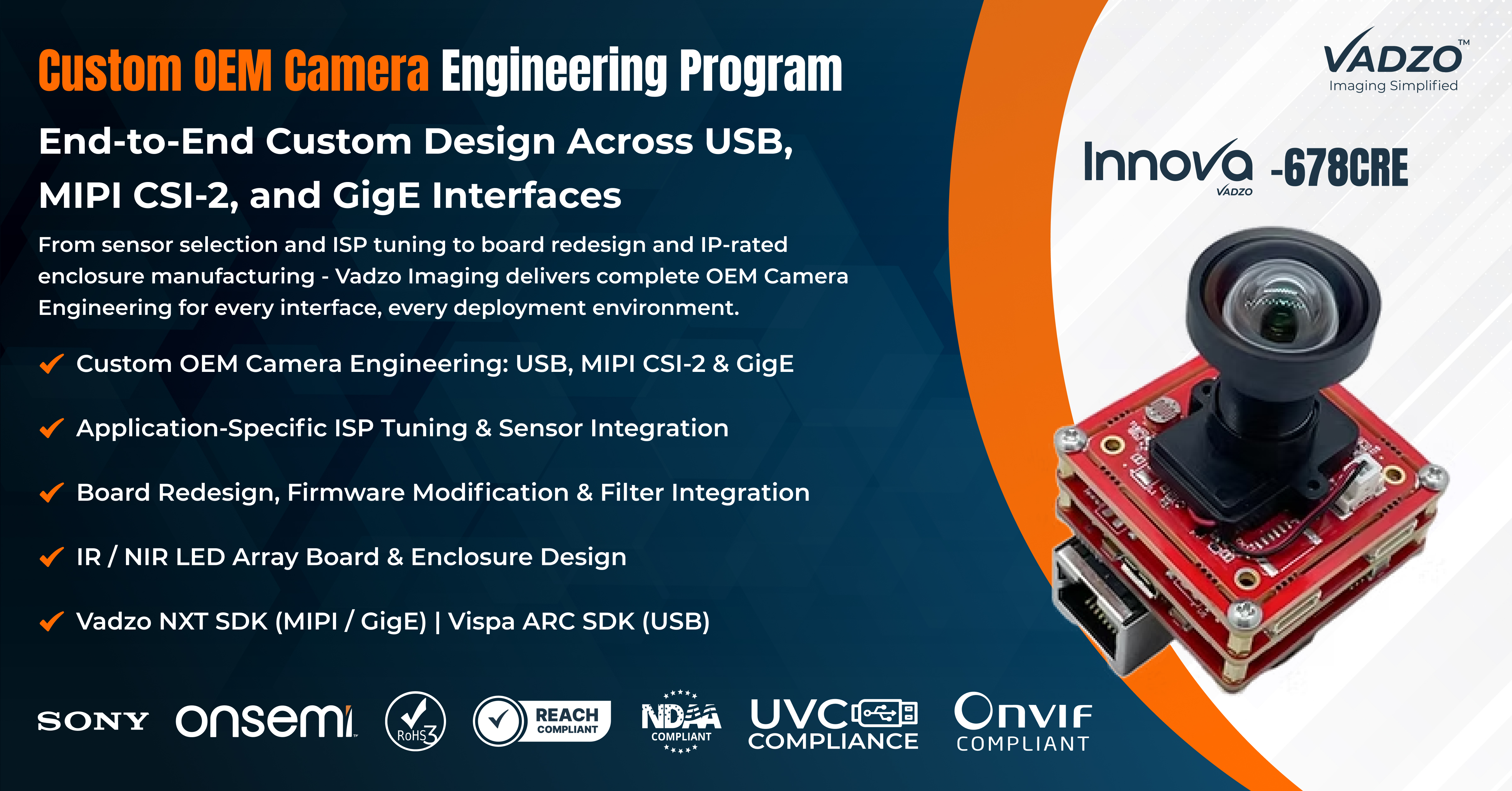
FORT WORTH, TX / ACCESS Newswire / May 19, 2026 / Vadzo Imaging, a provider of embedded vision camera, is formalizing what its engineering teams have delivered to OEM customers across industrial, medical, and smart infrastructure verticals for years: complete, end-to-end OEM Camera Engineering across every phase of the embedded camera product lifecycle. From sensor selection and ISP calibration through board-level redesign, enclosure integration, firmware customization, and volume production ramp, the OEM Camera Engineering program closes the gap between a catalog camera module and a production-ready embedded vision platform.
OEM hardware developers building a traffic monitoring camera, medical device camera, security camera, smart parking camera, or robotics camera face the same reality: off-the-shelf modules arrive with ISP parameters tuned for general-purpose conditions, board geometries that do not match the product enclosure, and SDK interfaces requiring significant integration work before the camera is usable in production. The OEM Camera Engineering program pairs engineering services with three camera platforms across Gigabit Ethernet, MIPI CSI-2, and USB, each an OEM camera design starting point matched to a distinct deployment environment.
Why OEM Camera Engineering Requires More Than a Catalog Module
The gap between an evaluation board and a shipping product is an engineering problem. Off-the-shelf camera modules arrive with ISP parameters tuned for general-purpose conditions, board geometries that do not match the product enclosure, and SDK interfaces requiring significant integration work before the camera is usable in production. A surveillance camera for outdoor perimeter infrastructure requires ISP tuning for simultaneous high-contrast daylight and deep-shadow scenes. A digital pathology camera demands pixel-level spatial uniformity that default register settings do not deliver. A kiosk or biometrics terminal requires board geometry matched to the housing, not a reference design footprint.
Vadzo Imaging selects best-in-class sensors from Onsemi and Sony, designs the camera module hardware around them, develops ISP tuning and firmware from scratch, and delivers production-ready cameras with in-house developed interface stacks – UVC for USB, Meridian ONVIF and Vortex RTSP for GigE, and platform-validated MIPI CSI-2 drivers for Jetson, Raspberry Pi, i.MX, STM, and MediaTek. The OEM Camera Engineering program covers the full scope from sensor selection through IP-rated enclosure delivery as a single engagement, supported by Vadzo NXT SDK for GigE and MIPI CSI-2 deployments and Vispa ARC SDK for USB camera deployments.
Innova-821CRE: 8.3MP Onsemi AR0821 HDR GigE Camera for Wide-Area OEM Camera Deployments
Wide-area outdoor deployments in traffic monitoring, smart city surveillance, and perimeter security networks demand 4K resolution with dynamic range capable of handling direct sunlight and deep shadow zones in the same frame, over cable runs that USB’s practical distance limit cannot support and without the separate power wiring that non-PoE infrastructure requires. The Innova-821CRE addresses this directly.
Built on the Onsemi AR0821 sensor with DR-Pix™ dual conversion gain BSI technology, the Innova-821CRE camera delivers 8.3MP (3848×2168) 4K color imaging with 140+ dB embedded HDR in a single exposure – eliminating motion artifacts while capturing accurate detail across extreme lighting differentials simultaneously. Multiple HDR modes – 3-exposure eHDR, 4-exposure eHDR, and line-interleaved HDR – give OEM engineers flexibility to tune for speed or dynamic range depending on the deployment scenario. The electromechanical IR-cut filter manages day-to-night transition without host-side intervention, and enhanced NIR sensitivity extends operational range into after-dark environments.
GigE connectivity supports cable runs up to 100 metres over standard Cat5e/Cat6 with Power over Ethernet (PoE 802.3af), delivering both power and data on a single cable and eliminating dedicated power infrastructure at each deployment node. ONVIF Profile S/T/G/M compliance enables direct integration with existing video management systems without proprietary driver dependencies. IEEE 1588 PTP synchronization supports frame-accurate multi-camera coordination for intersection monitoring, multi-angle surveillance, and synchronized capture deployments. GPIO provides external trigger and multi-camera sync. Vadzo NXT SDK delivers full API control over HDR mode, exposure management, Region of Interest, encoding, and firmware updates across Windows, Linux, and Android.
Key specs: 8.3MP (3848×2168) | Onsemi AR0821 DR-Pix™ BSI | Rolling Shutter | 1/1.7″ 2.1µm | GigE 100/1000Base-T | 140+ dB eHDR | ONVIF Profile S/T/G/M | IEEE 1588 PTP | PoE 802.3af | S-Mount M12 | IR-Cut Filter | GPIO | -30°C to +85°C
Bolt-900MGS: 3.2MP Sony IMX900 Monochrome Global Shutter MIPI Camera for High-Sensitivity Embedded Camera Engineering
Underground access points, perimeter zones under IR floodlight, and after-dark smart parking installations require a sensor that extracts maximum photon sensitivity from infrared illumination while producing images free of motion artifacts on subjects moving through monitored entry points. A color sensor wastes pixel area on Bayer interpolation that contributes nothing to NIR sensitivity. A rolling shutter produces distortion on anyone passing through an access gate at the moment of frame readout.
The Bolt-900MGS is built on the Sony Pregius S IMX900, a back-illuminated 1/3.1″ global shutter sensor with 2.25µm pixels optimized for NIR response across the full visible and near-infrared spectrum. At 3.2MP (2064×1552), it resolves sufficient detail for license plate capture, face detection at entry points, and inspection tasks where the subject is in motion and IR illumination is the primary light source. Global shutter eliminates the spatial-temporal distortion that rolling shutter introduces on moving subjects, making it the correct architecture for biometric terminals, access control, and any deployment where the camera or subject moves during the exposure window. Quad HDR up to 120 dB manages uneven illumination where IR-lit zones sit alongside near-total darkness in the same frame.
The Bolt-900MGS, a 3MP global shutter camera integrates over MIPI CSI-2 with Vadzo-developed platform drivers validated for NVIDIA Jetson, Raspberry Pi, and NXP i.MX platforms, eliminating carrier board development overhead and delivering deterministic sensor-to-NPU data transfer for edge AI inference pipelines. Vadzo NXT SDK provides full API control over HDR mode, gain, Region of Interest, and firmware updates. The compact 38mm×38mm form factor supports embedded camera design in space-constrained robotics vision cells and access terminal enclosures.
Key specs: 3.2MP (2064×1552) | Sony Pregius S IMX900 | Global Shutter | 1/3.1″ 2.25µm BSI | MIPI CSI-2 | Quad HDR 120 dB | NIR | S-Mount M12 | -40°C to +85°C
Falcon-2020CRS: 20MP Onsemi AR2020 HyperLux Color USB Camera for High-Resolution OEM Camera Design
Digital pathology platforms imaging tissue samples, AI camera engineering systems performing high-accuracy classification, and industrial inspection systems where color contrast distinguishes defect from substrate all require pixel density and color fidelity that lower-resolution modules cannot deliver – without the carrier board development overhead that MIPI CSI-2 or GigE deployment introduces.
The Falcon-2020CRS, a AR2020 camera delivers 20MP (5184×3840) color imaging over USB 3.2 Gen1, built on the Onsemi HyperLux AR2020 sensor with 1.4µm pixel pitch on a 1/1.8″ optical format. The spatial density supports AI inference pipelines that require high-accuracy detection and segmentation on complex scenes – tissue morphology, surface defect geometry, and multi-class object classification at pixel-level resolution. USB connectivity makes it immediately deployable on any Linux, Windows, or Android host without custom carrier board development, reducing integration time and cost for medical device camera prototyping, Raspberry Pi camera integrations, and drone payload designs where development speed is a constraint. ISP tuning as part of the OEM Camera Engineering program calibrates the AR2020 color response and lens shading correction to the specific illumination, intensity, and contrast of the target deployment. Vispa ARC SDK provides C, C++, and Python API access covering streaming, GPIO, Region of Interest, and firmware updates.
Key specs: 20MP (5184×3840) | Onsemi AR2020 HyperLux | Rolling Shutter | 1/1.8″ 1.4µm | USB 3.2 Gen1 | NIR | S-Mount | -30°C to +85°C
Vadzo NXT SDK and Vispa ARC: Developer Control Across GigE, MIPI CSI-2, and USB
The Innova-821CRE and Bolt-900MGS are supported under Vadzo NXT SDK, providing programmatic control over streaming, encoding, camera parameters, GPIO, Region of Interest, Smart GPIO, HDR mode selection, and firmware updates across C, C++, and Python on Windows, Linux, and Android. The Falcon-2020CRS runs under Vispa ARC, Vadzo’s USB embedded vision SDK, delivering equivalent API depth for USB camera deployments including Raspberry Pi integrations, kiosk terminals, and portable instrument designs. The Bolt-900MGS additionally supports V4L2-compliant MIPI CSI-2 driver integration with direct ISP connectivity on NVIDIA Jetson, Raspberry Pi, and NXP i.MX platforms for low-latency embedded vision deployment.
OEM Camera Engineering Applications
Traffic Monitoring, Smart City Surveillance, and Perimeter Security: Traffic monitoring and perimeter surveillance deployments require 4K color resolution with enough dynamic range to capture usable detail across direct sunlight and deep shadow, over cable runs where USB infrastructure cannot reach and separate power wiring adds deployment cost. The Innova-821CRE, a 8MP gigabit ethernet camera delivers 140+ dB eHDR over a single PoE Cat5e/Cat6 run up to 100 metres. ONVIF Profile S/T/G/M enables direct integration into existing VMS platforms without proprietary driver dependencies. IEEE 1588 PTP synchronizes multiple Innova-821CRE units frame-accurately for intersection monitoring and multi-angle surveillance deployments. ISP tuning calibrated for outdoor daylight-to-dusk lighting conditions ensures consistent output across the full operational day without per-installation adjustment.
Biometrics, Access Control, and Smart Parking: Biometrics terminals and access control systems need global shutter capture of a moving subject under IR illumination, free of motion artifacts, at a resolution sufficient for downstream biometric matching. Standard color rolling shutter cameras produce both Bayer interpolation losses in the NIR band and spatial distortion on subjects in motion – two failure modes the Bolt-900MGS, a 3MP mono camera eliminates at the sensor level. Quad HDR (120 dB) handles uneven IR illumination at perimeter nodes where lit zones meet near-total darkness. The compact MIPI CSI-2 form factor integrates directly into access terminal enclosures and smart parking camera housings with Vadzo-validated platform drivers for Jetson and Raspberry Pi.
Digital Pathology, Medical Device, and AI Camera Engineering: Digital pathology instruments, medical device camera platforms, and AI inference systems for high-accuracy detection require pixel density that lower-resolution sensors cannot deliver without stitching workflows – and color fidelity that uncalibrated ISP pipelines do not produce. The Falcon-2020CRS 20MP color camera delivers output over USB 3.2 Gen1 captures tissue morphology, surface defect geometry, and complex scene classification detail in a single frame. ISP color calibration and lens shading correction tuned by Vadzo to the specific deployment illuminant deliver clinically and analytically accurate output from the first frame. No custom carrier board development is required – the camera enumerates directly on Linux, Windows, and Android hosts, reducing integration time for medical device prototyping and AI pipeline development.
What Vadzo’s OEM Camera Engineering Program Delivers Across All Platforms
Across the Innova-821CRE, Bolt-900MGS, and Falcon-2020CRS, Vadzo provides the complete engineering stack that OEM product development requires beyond the camera module. ISP tuning is calibrated against real deployment lighting conditions – not generic defaults – across all three sensor platforms. Firmware is developed in-house, enabling custom feature integration, behavioral modifications, and long-term maintenance across product generations. Interface stacks are owned and maintained by Vadzo: Meridian ONVIF and Vortex RTSP for GigE, UVC for USB, and platform-validated MIPI CSI-2 drivers for Jetson, Raspberry Pi, i.MX, STM, and MediaTek.
Full OEM hardware customization covers board redesigns, lens holder and filter modifications, NIR and visible LED array board design and integration, advanced sensor integration including ToF, mmWave radar, and IMU, microphone and speaker integration, and IP-rated and non-IP-rated enclosure design and manufacturing. Vadzo’s in-house edge AI and cloud AI capability supports OEM programs that require inference pipeline co-development alongside the camera module. Volume pricing, production support, and direct applications engineering engagement for design-in and production ramp are available on request.
“Every OEM Camera Engineering engagement exposes the same gap: the ISP tuning is wrong for the environment, the board does not fit the enclosure, and the SDK needs months of integration work. We built this program to close all three in a single engagement across USB, MIPI CSI-2, and Gigabit Ethernet so OEM teams move from evaluation to production without rebuilding the camera from scratch.” – Alwin Vincent, Product Manager, Vadzo Imaging.
Frequently Asked Questions
1. What is the best 4K HDR GigE camera with ONVIF and PoE for traffic monitoring and smart city surveillance deployments?
Traffic monitoring and smart city surveillance deployments require a camera that captures license plate and vehicle detail across direct sunlight and deep shadow in the same frame, connects over standard network infrastructure without separate power wiring, and integrates with existing VMS platforms without proprietary drivers. The Innova-821CRE delivers 140+ dB embedded HDR from the Onsemi AR0821 DR-Pix™ sensor in a single exposure with no motion artifacts – handling the full dynamic range of outdoor daylight-to-dusk scenes without highlight clipping or shadow loss. PoE 802.3af delivers power and data over a single Cat5e/Cat6 cable across runs up to 100 metres, eliminating dedicated power infrastructure at each camera node. ONVIF Profile S/T/G/M compliance registers the camera directly on Milestone, Genetec, Avigilon, and other VMS platforms without custom middleware. IEEE 1588 PTP enables frame-accurate synchronization across multiple Innova-821CRE units for intersection monitoring and multi-angle surveillance.
2. Which MIPI camera with global shutter and NIR sensitivity is best for biometric terminals and IR-illuminated access control?
Biometric terminals and IR-illuminated access control deployments fail with rolling shutter color cameras on two counts – rolling shutter introduces spatial distortion on subjects moving through the capture zone, and color filter arrays absorb NIR wavelengths that IR illumination arrays emit, reducing effective sensitivity. The Bolt-900MGS Sony Pregius S IMX900 monochrome global shutter MIPI camera eliminates both failure modes. Global shutter captures the entire frame simultaneously regardless of subject motion. Monochrome capture preserves the full NIR signal at 850 nm and 940 nm without color filter absorption losses, delivering higher effective sensitivity under IR illumination than any color variant of the same sensor. Quad HDR up to 120 dB handles uneven illumination across IR-lit and dark zones in the same frame. Vadzo-validated MIPI CSI-2 drivers for Jetson, Raspberry Pi, and i.MX integrate the camera directly into access terminal and smart parking system compute platforms without custom driver development.
3. What is the difference between eHDR and line-interleaved HDR, and which mode is right for outdoor surveillance and traffic monitoring?
Outdoor surveillance and traffic monitoring deployments involve moving subjects – vehicles, pedestrians, cyclists – captured across scenes with simultaneous direct sun and deep shadow. Choosing the wrong HDR mode in this scenario produces motion artifacts that defeat license plate recognition and object detection algorithms. The Innova-821CRE eHDR modes – 3-exposure and 4-exposure – deliver 140+ dB dynamic range within a single sensor exposure, capturing all pixels simultaneously with no inter-frame motion artifacts. Line-interleaved HDR is the correct mode for scenes with moderate contrast where the priority is maximizing resolution within the HDR output. For outdoor traffic monitoring and perimeter surveillance where subjects are in motion and dynamic range headroom is the primary requirement, the eHDR modes are the correct choice. All three HDR modes are selectable at runtime via Vadzo NXT SDK without a firmware change.
4. Which 20MP USB camera supports AI inference pipelines and digital pathology without custom carrier board development?
AI inference pipelines for defect detection, tissue classification, and high-accuracy segmentation require pixel density that 5MP and 8MP sensors cannot provide at the field widths digital pathology and industrial inspection demand – and medical device camera prototyping programs need USB connectivity to avoid the carrier board development that MIPI CSI-2 integration requires. The Falcon-2020CRS delivers 20MP (5184×3840) color imaging over USB 3.2 Gen1, enumerating directly on Linux, Windows, and Android hosts without custom carrier board development. ISP color calibration and lens shading correction are tuned by Vadzo to the specific deployment illuminant, delivering accurate color and uniform flat-field output from the first frame. Vispa ARC SDK provides C, C++, and Python API access for streaming, ROI configuration, and firmware updates across the development environments AI and medical device software teams operate in.
5. What OEM customization does Vadzo’s Camera Engineering program cover across GigE, MIPI, and USB camera platforms?
OEM camera programs consistently stall when the catalog module does not fit the enclosure, the ISP is tuned for the wrong lighting conditions, or the interface stack requires months of integration work to function in the production environment. Vadzo’s OEM Camera Engineering program covers hardware customization including board redesigns, lens holder and filter modifications, NIR and visible LED array board design, advanced sensor integration including ToF, mmWave radar, and IMU, and IP-rated and non-IP-rated enclosure design and manufacturing. Firmware customization covers ISP parameter tuning, custom feature integration, and behavioral modifications for deployment-specific requirements. Interface stack customization is available across Meridian ONVIF and Vortex RTSP for GigE, UVC for USB, and MIPI CSI-2 platform drivers for Jetson, Raspberry Pi, i.MX, STM, and MediaTek. Vadzo’s in-house edge AI and cloud AI capability supports OEM programs requiring inference pipeline co-development alongside the camera module. Evaluation units are available with no minimum order requirement.
Availability
The Innova-821CRE 8.3MP HDR GigE Camera, Bolt-900MGS 3.2MP Monochrome Global Shutter MIPI Camera, and Falcon-2020CRS 20MP Color USB Camera are available now for OEM evaluation and production deployment with no minimum order requirement. Evaluation kits, technical documentation, Vadzo NXT SDK and Vispa ARC SDK access, and applications engineering support are available through the Vadzo Imaging team. For volume pricing, OEM customization, ISP tuning, firmware development, and enclosure design services, contact support@vadzoimaging.com.
About Vadzo Imaging
Vadzo Imaging is one of the few companies worldwide that selects best-in-class imaging sensors from Onsemi and Sony, designs production-ready camera modules around them, and delivers the complete engineering stack – ISP tuning and calibration, in-house firmware development, UVC stack for USB, Meridian ONVIF and Vortex RTSP stacks for GigE, and platform-validated MIPI CSI-2 drivers for Jetson, Raspberry Pi, i.MX, STM, and MediaTek – from a single engineering team based in India. Vadzo supports USB, MIPI CSI-2, GigE Vision, Wi-Fi, GMSL2, and FPD Link III interfaces, with LTE on the active roadmap. In-house edge AI and cloud AI capability enables Vadzo to support OEM programs from sensor selection through inference pipeline deployment. OEM customization covers board redesigns, firmware, advanced sensor integration including ToF, mmWave radar, and IMU, and IP-rated enclosure design and manufacturing. Visit vadzoimaging.com to explore the full camera portfolio.
Media Contact
Alwin Vincent
Vadzo Imaging
Email: alwin@vadzoimaging.com
LinkedIn: Vadzo Imaging
YouTube: Vadzo Imaging
X: Vadzo Imaging
SOURCE: Vadzo Imaging
View the original press release on ACCESS Newswire


