The Business Research Company’s Airborne Collision Avoidance System Global Market Report 2026 – Market Size, Trends, And Forecast 2026-2035
LONDON, GREATER LONDON, UNITED KINGDOM, November 12, 2026 /EINPresswire.com/ — The airborne collision avoidance system market has been making significant strides in recent years, driven by advancements in aviation safety and increasing air traffic. As the industry evolves, this market is set to experience continued growth, supported by technological innovations and expanding global air travel. Let’s explore the current market size, key growth factors, regional leaders, and emerging trends shaping this sector.
Current Market Size and Expected Growth Trajectory for the Airborne Collision Avoidance System Market
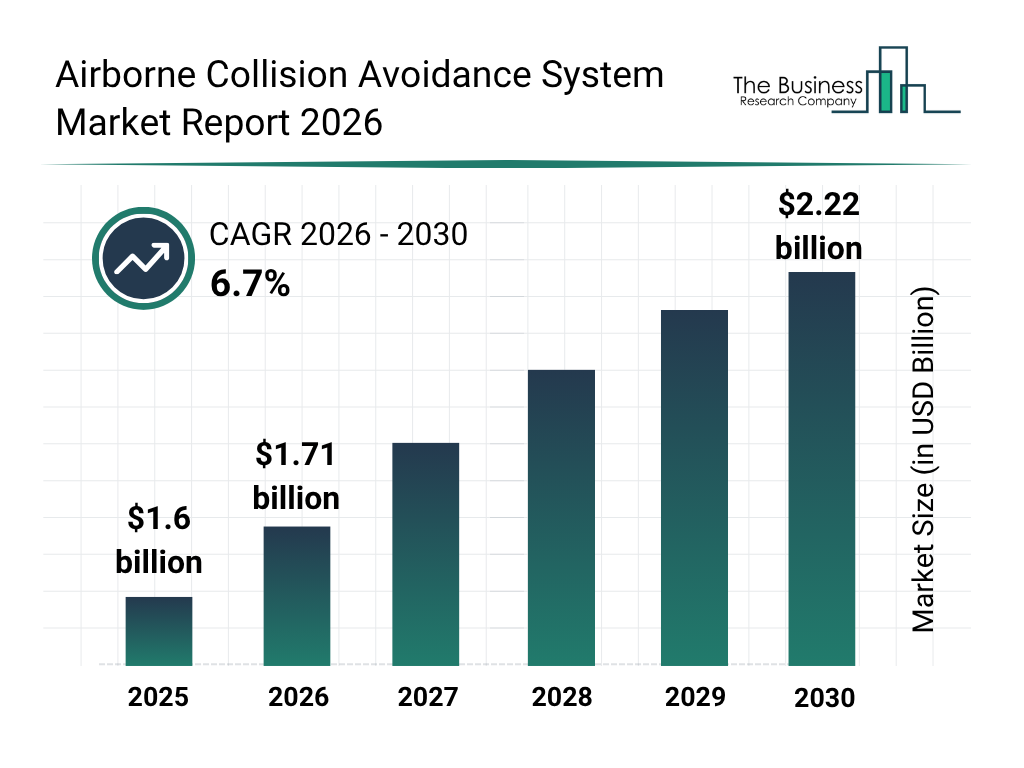
In recent times, the airborne collision avoidance system market has experienced robust expansion. It is projected to grow from $1.6 billion in 2025 to $1.71 billion in 2026, reflecting a compound annual growth rate (CAGR) of 7.2%. This past growth has been driven mainly by a stronger emphasis on preventing aircraft collisions, increased adoption of airborne traffic surveillance systems, heightened regulatory focus on aircraft separation, a growing fleet of commercial airplanes, and a greater need for enhanced situational awareness in cockpits.
Download a free sample of the airborne collision avoidance system market report:
https://www.thebusinessresearchcompany.com/sample_request?id=67602669&type=smp&name=Airborne%20Collision%20Avoidance%20System%20Market%20Report%202026&utm_source=EINPresswire&utm_medium=Paid&utm_campaign=Nov_PR
Looking ahead, the market is expected to continue its strong upward trajectory, reaching $2.22 billion by 2030 at a CAGR of 6.7%. The forecast period growth will be fueled by the rising demand for next-generation collision avoidance systems, broader integration of advanced traffic detection technologies, growing use of collision avoidance solutions for unmanned aircraft, increasing deployment of portable systems, and the need for interoperable aircraft surveillance. Key trends anticipated during this time include wider adoption of automatic avoidance features, better integration of advanced surveillance sensors, improved aircraft-to-aircraft data exchanges, expanded use of real-time conflict detection, and enhanced cockpit traffic display solutions.
Understanding Airborne Collision Avoidance Systems and Their Role in Aviation Safety
Airborne collision avoidance systems are critical safety tools installed onboard aircraft to monitor nearby planes and detect potential collision risks using surveillance and traffic data. These systems provide pilots with timely traffic information and, when necessary, offer automated guidance or advisories to safely maneuver and maintain proper separation. Their primary goal is to reduce the chances of mid-air collisions, enhancing overall flight safety.
View the full airborne collision avoidance system market report:
https://www.thebusinessresearchcompany.com/report/airborne-collision-avoidance-system-market-report?utm_source=EINPresswire&utm_medium=Paid&utm_campaign=Nov_PR
How Increasing Air Passenger Traffic Stimulates the Airborne Collision Avoidance System Market
One of the most important factors driving the expansion of the airborne collision avoidance system market is the increasing volume of air passenger traffic. This metric represents the total number of passengers traveling via airlines or through airports over a certain timeframe and is a key indicator of air travel demand. Growth in passenger traffic results from airline network expansions and new route additions, which improve connectivity and make flying more accessible and convenient.
As more aircraft share the skies, the need for advanced safety mechanisms like collision avoidance systems becomes critical to prevent accidents and ensure safe flights. For example, in December 2025, the International Air Transport Association (IATA) forecasted a 4.9% year-over-year increase in passenger traffic for 2026, measured in revenue passenger kilometers (RPK). The Asia-Pacific region is expected to lead this growth with a 7.3% increase. This rising demand for air travel directly supports the growth of airborne collision avoidance system deployments.
Leading Regional Markets in Airborne Collision Avoidance Systems
In 2025, North America held the largest share of the airborne collision avoidance system market, reflecting its mature aviation infrastructure and high safety standards. However, the Asia-Pacific region is projected to experience the fastest growth throughout the forecast period, driven by rapid air traffic increases and expanding commercial fleets. Other regions covered in the market analysis include South East Asia, Western Europe, Eastern Europe, South America, the Middle East, and Africa, each contributing uniquely to the global market landscape.
Our 2026 market reports now offer broader strategic coverage through market attractiveness scoring and analysis, total addressable market (TAM) analysis, company scoring matrix graphics and tables, Excel-based forecasting dashboards, market hotspots infographics, key technologies and future trend analysis, along with updated graphics and tables.
Speak With Our Expert:
Saumya Sahay
Americas +1 310-496-7795
Asia +44 7882 955267 & +91 8897263534
Europe +44 7882 955267
Email: marketing@tbrc.info
The Business Research Company – www.thebusinessresearchcompany.com
Follow Us On:
• LinkedIn: https://in.linkedin.com/company/the-business-research-company“
Oliver Guirdham
The Business Research Company
+44 7882 955267
info@tbrc.info
Visit us on social media:
LinkedIn
Facebook
X
Legal Disclaimer:
EIN Presswire provides this news content “as is” without warranty of any kind. We do not accept any responsibility or liability
for the accuracy, content, images, videos, licenses, completeness, legality, or reliability of the information contained in this
article. If you have any complaints or copyright issues related to this article, kindly contact the author above.

Media gallery