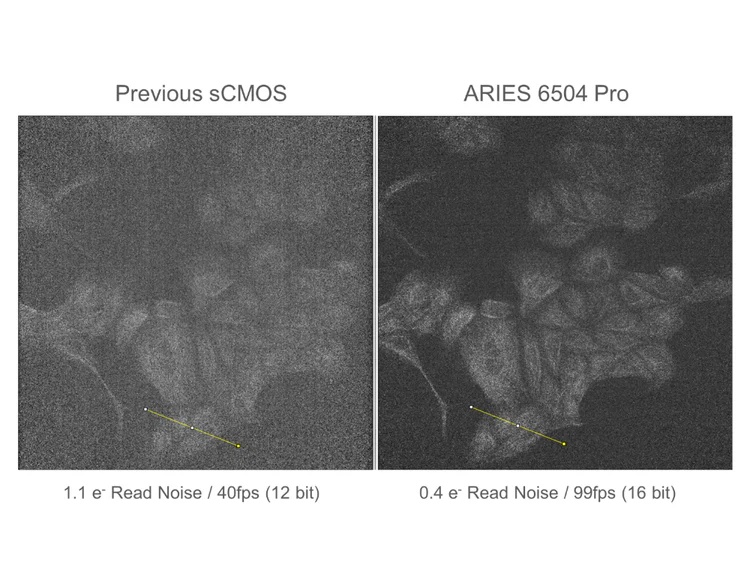
Tucsen Photonics are now shipping the most sensitive sCMOS camera – More sensitive and faster than all others available
BIRMINGHAM, WEST MIDLANDS, UNITED KINGDOM, May 18, 2026 /EINPresswire.com/ — Tucsen has started shipping the Aries 6504 Pro, a 4-megapixel scientific CMOS camera that may represent the most sensitive sCMOS camera available for low-light detection applications.
The claim comes with an important qualifier: sensitivity depends on the application. Tucsen’s analysis focuses specifically on detection sensitivity — the ability to detect faint targets, shapes, features, and structures at very low signal levels — rather than simply comparing headline specifications.
The Aries 6504 Pro combines 6.5-micron pixels, 95% peak quantum efficiency, and read noise down to approximately 0.4 electrons. Tucsen argues that this combination gives the camera a decisive advantage in low-light fluorescence microscopy, where high signal-to-noise ratio is critical for detecting weak biological signals.
Unlike earlier low-noise sCMOS designs that relied on slower correlated multisampling modes, the Aries 6504 Pro delivers sub-electron read noise while retaining 16-bit imaging and high-speed operation. The camera can also operate at 297 fps full frame with approximately 0.8 electrons of read noise in high-speed mode, available on both the Aries 6504 and Aries 6504 Pro.
Tucsen’s comparison work models performance at low photon levels across common fluorescence microscopy wavelengths, including blue, green, red, and far-red emissions. At a 5-photon signal level, the company reports that the Aries 6504 Pro achieves higher expected SNR than other 6.5-micron-pixel sCMOS cameras assessed in the comparison.
The company also compares the Aries 6504 Pro against newer qCMOS and EMCCD technologies. While qCMOS cameras can achieve extremely low read noise in slow-scan modes, Tucsen’s analysis suggests that quantum efficiency and pixel size shift the practical SNR advantage back toward the Aries 6504 Pro in fluorescence microscopy applications. Against EMCCD, the company notes that while larger EMCCD pixels can improve system sensitivity, excess noise remains a disadvantage when pixel size is normalized through binning.
“Calling any camera the most sensitive requires context,” said James Francis, Strategic & Expansion Director at Tucsen Photonics. “For detection sensitivity in the low-light fluorescence examples we modeled, the Aries 6504 Pro delivers the highest SNR of the cameras compared. That is what makes this launch so important for researchers trying to detect weak signals with confidence.”
Tucsen emphasizes that no camera is universally best for every application. Larger sensor formats, faster cameras, global shutter sensors, and TDI cameras may be better suited elsewhere. However, for researchers prioritizing detection sensitivity in low-light microscopy, the Aries 6504 Pro is positioned as Tucsen’s strongest solution to date.
Availability:
The Aries 6504 and Aries 6504 Pro are now shipping worldwide.
Product Information:
Aries 6504 Pro Product Page
Pricing Information:
Most Sensitive sCMOS Overview & Pricing
James Francis
Tucsen Photonics UK Ltd
1217519789 ext.
email us here
Visit us on social media:
LinkedIn
Legal Disclaimer:
EIN Presswire provides this news content “as is” without warranty of any kind. We do not accept any responsibility or liability
for the accuracy, content, images, videos, licenses, completeness, legality, or reliability of the information contained in this
article. If you have any complaints or copyright issues related to this article, kindly contact the author above.

Media gallery