
Key takeaways
- A post-workout sauna makes the most sense after the normal cooldown, once heart rate has begun to settle; most users wait 10 to 30 minutes.
- A practical starting point is 10 to 15 minutes, built up gradually over several weeks. Hard training days call for shorter, easier sessions rather than more heat.
- Sweat removes fluid and electrolytes, so rehydration continues before, during, and after the sauna.
- Repeated post-training heat has produced measurable adaptations in traditional sauna and hot-water studies; evidence for faster immediate recovery and better next-day performance remains mixed.
- Most of that research used hot-air saunas or hot-water immersion, not a radiant near infrared tent, so the findings are reported rather than borrowed.
Why timing matters after a workout
A workout does not end physiologically at the final repetition or interval. Heart rate stays elevated, body temperature sits above baseline, and sweating may continue through the cooldown. Adding sauna heat immediately adds another thermal load before those responses have settled. The more conservative sequence is to finish the exercise cooldown first, spend roughly 10 to 30 minutes at room temperature with water in hand, and enter the sauna once heart rate and breathing have calmed. The gap does not need to be rigid; the point is to separate hard exercise from deliberate heat exposure rather than running them as one uninterrupted high-stress block. After an evening workout, the sequence is simple: training, cooldown, rehydration, sauna, a cool-down back toward room temperature, and then the normal evening routine. The sauna is an addition to the recovery period, not another training block.
Start with 10 to 15 minutes, not the maximum session
A trained body enters a post-workout sauna already warm, which changes the right starting dose. About 10 to 15 minutes is a reasonable beginning for someone adding heat after exercise, with duration adjusted gradually over several weeks according to tolerance rather than jumping to a long session. Training intensity shapes the session too. After an easy workout, a person may tolerate heat differently than after hard intervals, a long endurance session, or demanding resistance training, and a useful rule is: hard days, easy saunas. Longer is not automatically better; heat adds to the total stress of the day, and the purpose of the session is not to see how much additional strain can be accumulated. That distinction matters when research protocols come up. Some studies used 30 or even 40 minutes of post-exercise heat as part of deliberate heat-acclimation programs. Those were structured research interventions, not evidence that every routine workout should be followed by the same dose.
What traditional sauna research has found
Some of the clearest physiological evidence comes from repeated post-training sauna exposures. Stanley and colleagues, reporting in the European Journal of Applied Physiology, had well-trained cyclists sit 30 minutes in a traditional sauna at about 87 degrees Celsius immediately after normal training. Plasma volume increased substantially with repeated exposures, peaking after four sessions. The study examined plasma-volume and heart-rate responses rather than an immediate recovery benefit. A 2022 multi-arm randomized controlled trial compared eight weeks of exercise alone with the same exercise followed by 15 minutes of sauna, and reported additional improvements in cardiorespiratory fitness, systolic blood pressure, and total cholesterol in the exercise-plus-sauna group. It used a traditional sauna rather than a near infrared radiant enclosure. These studies support the idea that repeated heat after training can produce measurable adaptations. They do not establish that a single session makes muscles recover faster, removes soreness, or guarantees better performance the next day.
Heat acclimation is different from everyday recovery
Post-exercise heat has also been studied as a way to acclimate athletes to hot conditions. Zurawlew and colleagues had participants run for 40 minutes and then soak for 40 minutes in water at 40 degrees Celsius for six consecutive days. The researchers reported heat-acclimation adaptations and improved endurance performance in hot conditions after the intervention. That experiment matters, but it was hot-water immersion, not sauna use; water transfers heat differently from air or radiant energy, so the protocol is not a direct test of a sauna. It also had a specific purpose. A structured protocol designed to prepare for exercise in the heat is different from a short sauna session after an ordinary gym workout, and confusing the two goals leads to unnecessarily long heat sessions.
What research says about recovery and performance
The evidence is less certain when the question shifts from long-term adaptation to immediate recovery. A 2025 systematic review of post-exercise heat found promising but heterogeneous results, with some studies reporting improved recovery or performance and others little effect. A separate 2025 meta-analysis concluded that effects on performance remain uncertain because most studies are small and the quality of evidence is low. That produces a useful distinction. Repeated post-training heat can create heat-acclimation and related physiological adaptations under appropriate protocols. Evidence that a sauna reliably speeds acute recovery, reduces next-day soreness or improves the next workout is much less settled. Many regular users report feeling less sore and sleeping well after a post-training session, and warmth with gentle movement does feel good on worked muscles, but that is comfort and support alongside the fundamentals of recovery: appropriate training load, food, fluids, rest and sleep.
Rehydration comes before and after the sauna
Exercise already produces substantial sweat losses, and a post-workout sauna extends them. Sweat is mostly water and carries electrolytes, chiefly sodium with smaller amounts of potassium and magnesium, so the losses need to be considered across the workout and the sauna together. Rehydration should begin during the cooldown and continue through and after the session rather than waiting until everything is finished. A simple low-tech indicator is urine gradually returning toward a pale straw color. Food helps as well.
Gentle movement fits the post-workout window
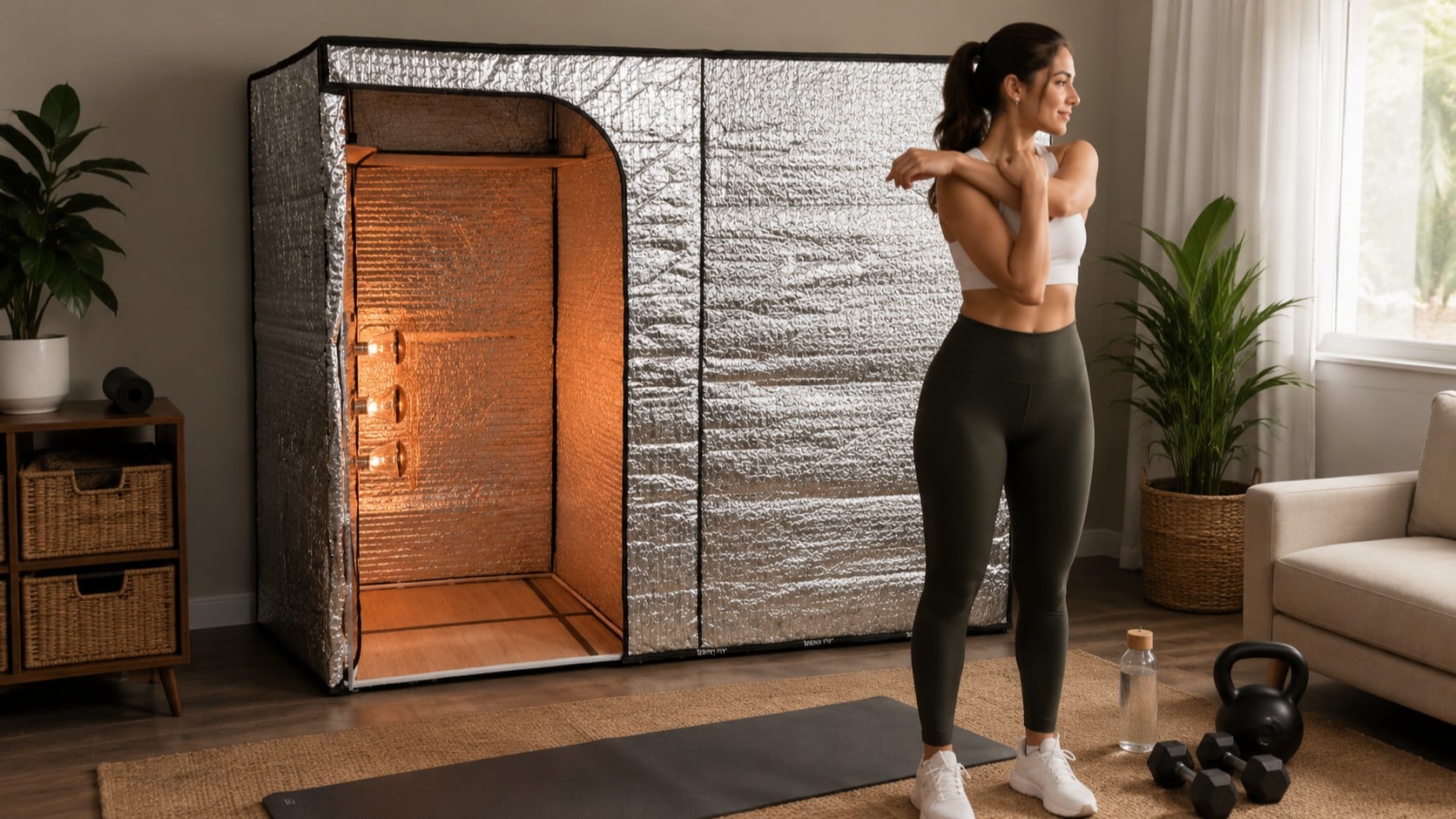
Warmth is a comfortable time for simple range-of-motion work after training, as long as it stays easy. The Sauna Fix® Exercise Sauna is a radiant tent with enough room for gentle stretching and mobility work inside the heat. That does not turn the sauna period into another exercise session. Slow shoulder movement, an easy hamstring stretch, comfortable hip mobility, or relaxed spinal movement all fit, with static positions kept inside a normal comfortable range rather than pushed farther because warmth changes how a stretch feels. Foam rolling can follow once the person has left the enclosure. Post-workout heat and gentle mobility belong to the recovery period; they are not extra training volume.
Before you begin
A post-workout sauna is best approached as a separate heat exposure placed after the work is done. The cooldown comes first, rehydration begins next, and once heart rate has settled, a beginner starts with about 10 to 15 minutes and builds gradually. Hard workouts warrant shorter, easier sessions. Dizziness, nausea, headache, unusual weakness, or a heart rate that will not settle are reasons to leave the heat and cool down, and a sauna is never taken dehydrated or after alcohol. Anyone new to heat, pregnant, managing a heart or blood-pressure condition, or taking medications affected by heat or fluid shifts should talk with a healthcare professional first. The strongest research supports repeated post-exercise heat as a way to produce heat-related adaptations; evidence for faster immediate recovery and consistently better next-day performance is promising in places and uncertain overall, and because it comes from hot-air saunas and hot-water immersion, it is not presented here as demonstrated in a radiant near infrared tent.
Creatrix Solutions
contact@creatrixsolutions.com
+1-866-686-5605
214 E Albany Avenue
Building E101
Kennewick
WA
99336
United States


